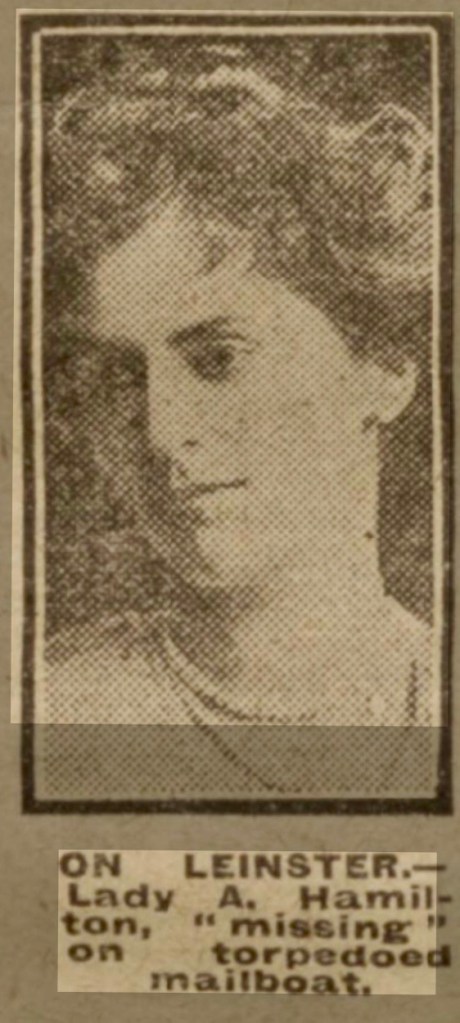
Lady Phyllis Hamilton, picture courtesy of RMS Leinster Memorial Page
On 10 October 1918, a month and a day before the end of the Great War, the mail boat RMS Leinster was sunk by a German U-boat, with the loss of more than 500 lives. Although the official death toll was placed at 501, on the strength of recent research at least 565 people perished in what remains the greatest single loss of life in the Irish Sea.
The Leinster was one of four ships owned by the City of Dublin Steam Packet Company to operate a mail and passenger service between Kingstown and Holyhead in Anglesey. The other three ships were named RMS Connaught, RMS Munster and RMS Ulster. Collectively they were known as the ‘Provinces’. The prefix RMS is the abbreviation for Royal Mail Steamer.
Shortly before 9 am on 10 October the Leinster left Kingstown, under the command of Captain William Birch, a Dubliner who lived with his family in Holyhead. The ship had a crew of 77 and was carrying 694 passengers, of whom approximately 190 were civilians. The remainder were service personnel either returning to their units or going on leave. Some were nurses. Some of the service personnel were from Australia, New Zealand, Canada and the United States.
The most prominent Ulster casualty was Lady Alexandra Phyllis Hamilton, the 42-year-old daughter of James Hamilton, the 2nd Duke of Abercorn. She was travelling to London, accompanied by the family cook, Mrs Martha Bridge, and Eleanor Strachan, a servant.
Lady Phyllis remained calm and handed her lifejacket to someone else, observing, ‘I’m a strong swimmer.’ The Princess of Wales (the future Queen Alexandra and consort of Edward VII) had acted as sponsor at her baptism. She was also a cousin of Winston Churchill and one of five close relatives whom Churchill lost in the Great War. Of three members of the party, only Mrs Bridge’s body was ever recovered.
There is a memorial to Lady Phyllis and Lady Gladys Mary Hamilton, the Countess of Wicklow, erected by the Dowager Duchess of Abercorn, inside the beautiful little Church of Ireland church on the Baronscourt estate, near Newtownstewart. The Countess had died the previous year, aged 36.
Another significant casualty was Josephine Carr, the first Wren to die on duty. Daughter of Samuel and Kathleen Carr of 4 Bethesda Road, Blackrock, County Cork, she had enlisted in the newly-created Women’s Royal Naval Service (WRNS) in September 1917. She was 19 and was described as a clerk/shorthand typist. Josephine’s body was never recovered.
The sinking of the RMS Leinster attracted stern comment from President Woodrow Wilson who observed on 14 October: ‘At the very time that the German government approaches the government of the United States with proposals of peace its submarines are engaged in sinking passenger ships at sea.’
Germany responded on 20 October by agreeing to cease hostilities against merchant ships. The attacks stopped the following day.
 The Ulster History Project