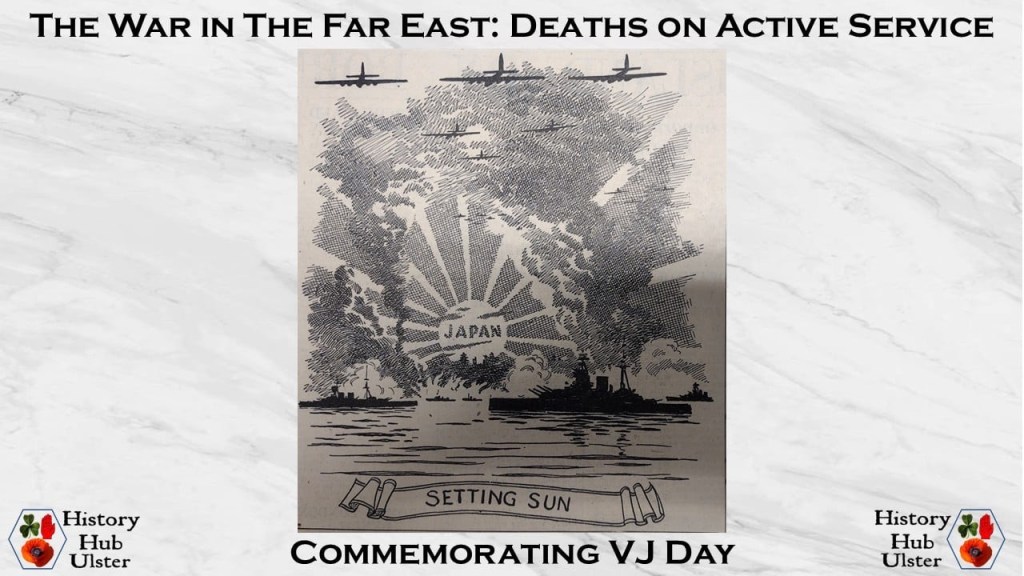
War in the Far East and VJ Day

The UHP have lined up local historian Nigel Henderson from the History Hub Ulster to speak on the war in the Far East against Imperial Japan.

This VJ Day (15th August 1945) saw the end of the war against Imperial Japan and subsequently the end of WW2, four months after the fall of Berlin.

Nigel Henderson says:


“There are at least thirty-six family memorial in graveyards in Northern Ireland which commemorate men and women who died on active service in the Far East Theatre of War. I am aware of family memorials in Greater Belfast and in each county in Northern Ireland, with the exception of Tyrone.

“In this talk, I will relate biographies for a selection of the fatalities, ensuring that each county (including Greater Belfast) is covered. The talk will include a civilian fatality and a female fatality.”

It takes place on VJ Day (15th August 2025) in Ballynafeigh Orange Hall, Ormeau Road, Belfast at 8pm.

All welcome!

Email info@ulsterhistoryproject.org.uk to register your interest.

Unionist Futures: forty years on from the Anglo-Irish Agreement

On Saturday 22nd November at 11 am the Ulster History Project will be hosting a talk marking the fortieth anniversary of the Anglo-Irish Agreement.

The lecture will be hosted at the Enniskillen Room, Museum of Orange Heritage (Schomberg House), Cregagh Road, Belfast with car parking available. Cost per person is free.

Register your interest today by emailing: info@ulsterhistoryproject.org.uk

The Speaker is Emeritus Professor Arthur Aughey, author of Under Siege: Ulster Unionism and the Anglo-Irish Agreement.

ULSTER HISTORY PROJECT MARKS CENTENARY OF NORTHERN IRELAND

PRESS RELEASE

22nd May 2021

The Ulster History Project, in conjunction with the NI Centenary Historians Sub-Committee, marked the centenary of Northern Ireland on Saturday through hosting a successful conference which attracted a range of participants, including Unionist politicians from across the board.

The conference looked at the history of Northern Ireland from its foundation, to include the role of women in the Province, the first elections to the new Parliament, the extraordinary career of Harry Midgley, Southern Unionists and Northern Ireland, the UVF Patriotic Fund (1913 – 1966) and how the new Northern Ireland state strove to present itself to a wider world.

Speakers included: Dr Andrew Charles, Gordon Lucy, Prof Graham Walker, Cllr Aaron Callan, Molly Liggett, Carol Walker, Philip Orr and Stewart McClean.

Speaking today, Chairman of the UHP, Cllr Richard Holmes said:

“It was great to mark the centenary of Northern Ireland through the medium of a Conference with a range of speakers, speaking on a wide variety of topics. The conference was well attended and supported by members from all the main Unionist parties, including MP Ian Paisley.

“Northern Ireland has a rich past worthy of further exploration and at the conference we had speakers who explored subjects from the first elections to the new Parliament in 1921, the formation of Northern Ireland, the experiences of southern Unionists, how the new state sold itself to the outside world and the career of Harry Midgley.

“Given the success of this conference, there are plans afoot to host another conference later in the year, in-person, looking to the future of Northern Ireland.”

Dr Andrew Charles, who organised the Conference and is Chairman of the NI Centenary Historians Sub-Committee said:

“What we wanted to do was to celebrate the centenary of Northern Ireland through a series of speakers and topics.

“I was heartened by the turnout and interest in the Conference and dialogue that grew out of each of the papers amongst the participants.

“It is clear that people, one hundred years on, wish to know more about the history of our Province.”

ENDS

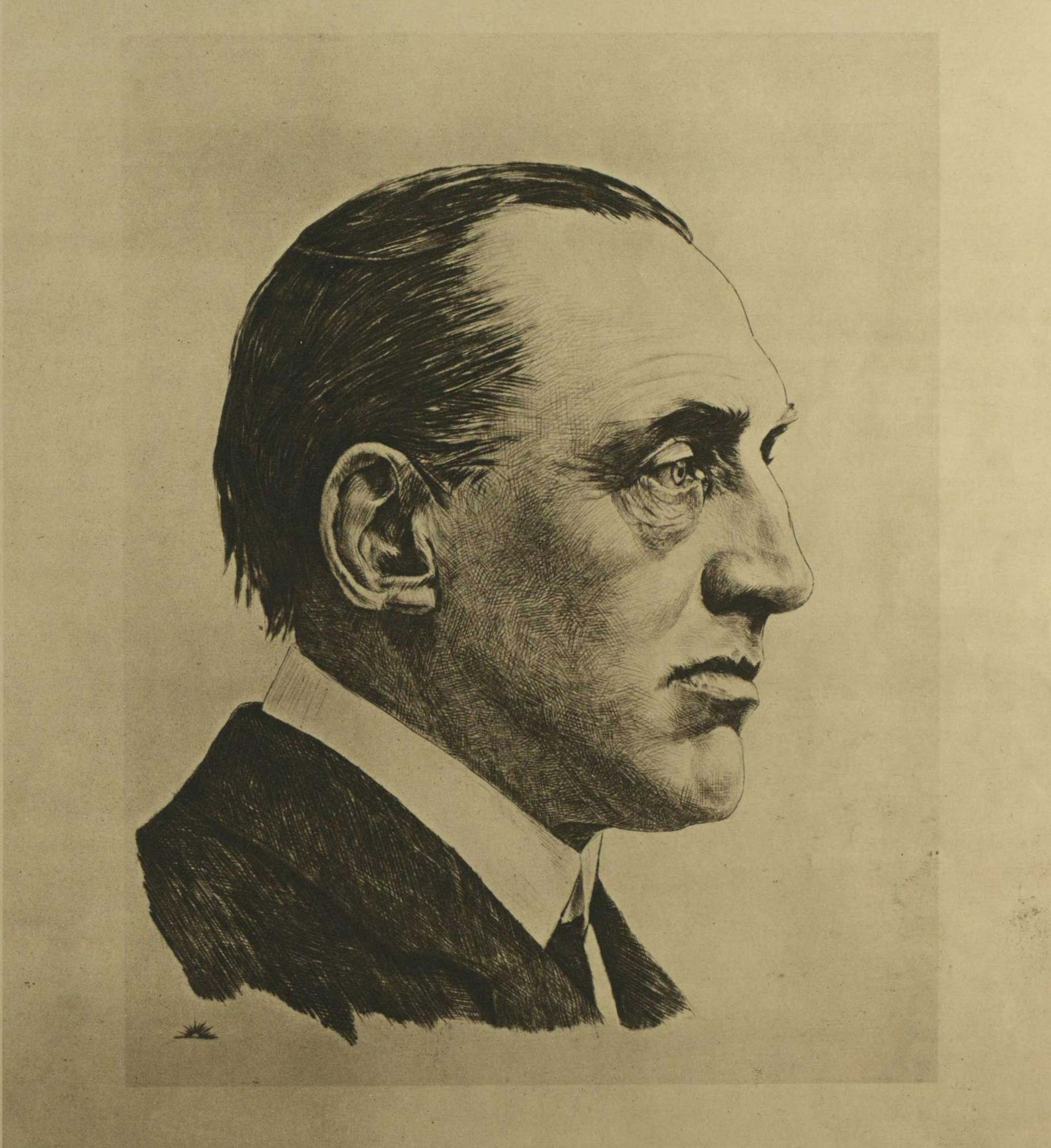
Sir Edward Carson as First Lord of the Admiralty

EDWARD CARSON 1914 (1)

‘More than any single person’ (in the words of the historian Robert Blake), Sir Edward Carson was responsible for the fall of Asquith’s administration and the formation of the Lloyd George coalition government in December 1916. Lloyd George told Frances Stevenson, his mistress, personal secretary and confidante who became his second wife in October 1943,  that he had no particular desire for the premiership and that he would have been happy to allow Asquith to run ‘his show (i.e. the Cabinet)’ but he did want control of the war effort.

Lloyd George wished to achieve this through the creation of a small war committee, a structure which Carson had also advocated, for the more efficient management of the nation’s manpower and material resources.

Asquith resigned as Prime Minister in early December 1916. Although he may have regarded the move as essentially tactical, it proved permanent and Lloyd George became Prime Minister in his place – as Carson wished.

Lloyd George offered Carson the position of Lord Chancellor, the greatest prize available to a member of the legal profession but Carson declined and indicated his desire to become a member the war committee (which was to become the War Cabinet) without portfolio.

Lloyd George originally intended appointing Lord Milner, a Liberal Imperialist with radical views which corresponded closely to Lloyd George’s own on domestic politics, to the role of First Lord of the Admiralty and appointing Carson to the War Cabinet. For whatever reason (and Lloyd George claimed he was pressured into the switch by the Conservative Party), Lloyd George changed his mind and appointed Carson to the Admiralty and Milner to the War Cabinet. Thus Carson held ‘one of the most demanding of wartime offices’ at a critical juncture of the war.

In his entry on Carson in the Oxford Dictionary of National Biography, D. George Boyce observed Carson ‘proved a surprisingly ineffective minister … Carson’s real power lay, as it did in his legal career, in his strength of critical attack’ and in doing so Boyce is simply reiterating the conventional wisdom on the subject.

Keith Grieves in his book, Sir Edward Geddes: Business and Government in War and Peace, writes thatHe [Geddes] was unimpressed by Sir Edward Carson’s somnolent political leadership as First Lord of the Admiralty and felt that an unwillingness to alter existing, largely pre-war procedures had resulted in an extreme form of naval defensiveness, which the scale of merchant loss symbolised.’

Are these assessments accurate? Are they not shaped by taking Lloyd George’s extremely self-serving post-war memoirs at face value and Sir Edward Geddes’ equally egotistical self-evaluation of his achievements as Carson’s successor? It is highly significant that Winston Churchill in his history of the First World War – The World Crisis gave Carson full credit for the measures he took as First Lord of the Admiralty.

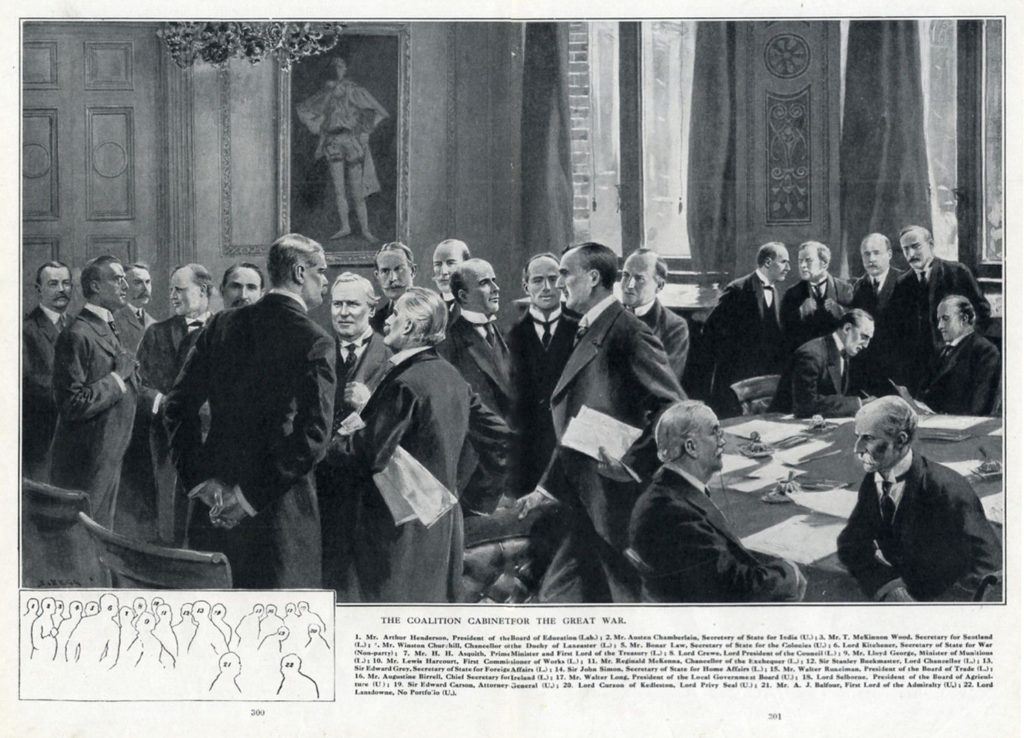
Carson-at-the-table-of-the-1915-War-Cabinet-1024x738 (1) (1)

As new First Lord of the Admiralty, Carson very quickly forged an excellent working relationship with Admiral Sir John Jellicoe, the new First Sea Lord.

Both men formed a high opinion of each other. Of Jellicoe, Carson recalled, ‘He was in my opinion the best man at his job that I met with in the whole war for knowledge, calmness, straightness and the confidence he inspired in his officers.’ Jellicoe in his memoir entitled The Crisis of the Naval War wrote of Carson, ‘His devotion to the naval service was obvious to all, and in him the Navy possessed indeed a true and powerful friend.’

Their period in office coincided with mounting U-boat attacks on Allied shipping. In last four months of 1916 U-boats had doubled the average monthly losses in Allied and neutral merchant shipping from 75,000 tons to 158,000 tons. During 1916 the number of U-boats in service rose from 58 to 140. In early 1917 the situation became even more grim because in January 1917 the German High Command decided to resume unrestricted submarine warfare.  By sinking enough merchant shipping, the Germans hoped to bring the United Kingdom to her knees and starve the country out of the war. Although unrestricted submarine warfare carried with it a high risk of provoking United States entry into the war, the Germans believed it was a risk worth taking because meaningful United States intervention in the conflict would come too late. Unrestricted submarine warfare began on 1 February 1917.

With the benefit of hindsight, we know that the answer to U-boat peril was the introduction of the convoy system. However at the time there was genuine concern that a convoy presented a larger and easier target to U-boats, and was more difficult  to defend, raising the prospect  of increasing rather reducing the submarine threat. It was also felt that the difficulty of coordinating a rendezvous would maximise the vulnerability of merchant ships when they were in the process of assembling. There were reservations too about whether the skippers of merchant vessels could manoeuvre in company, not least because different ships would have various top speeds. And finally could they be realistically expected to keep station?

Nevertheless, in January and February 1917 Carson and Jellicoe introduced the convoy system on the Scandinavian coal and trade routes to see if the convoy system would work. In mid-April 1917 they introduced a new convoy route to Gibraltar.

On 30 April 1917 Lloyd George – according to his memoirs which appeared in 1934 – descended on the Admiralty building where he allegedly demanded and won changes. Lloyd George also claimed that Jellicoe had always opposed the convoy system. Asked about this the day after the publication of Lloyd George’s memoirs, Carson did not mince his words in responding, ‘It is the biggest lie ever was told!’ The idea that Lloyd George, after a hard struggle, sat in the First Lord’s chair and imposed convoys on a hostile Board of the Admiralty is a myth of his own creation.

The entry of the United States into the war completely transformed the situation. The United States was able to supply the necessary escort vessels. The system was rapidly organised with such efficiency that, though the losses in shipping remained heavy until the autumn of 1917, the impact of the U-boat campaign was greatly diminished.

The close working relationship between Carson and Jellicoe is a subject for another occasion.

Lloyd George once said of Winston Church­ill: ‘He would make a drum of out of the skin of his own mother in order to sound his own praises’. The same might be said of Lloyd George with even greater force. In his memoirs Lloyd George seemed to feel the need to denigrate the efforts of others in order to enhance his own reputation. In many respects, this was wholly unnecessary because his achievements did not require embellishment at the expense of others. His treatment of Douglas Haig – who was dead by the time Lloyd George’s memoirs appeared – conforms to this well-establish pattern.

Carson had few illusions about Lloyd George at any stage in his political career. Comparing Asquith and Lloyd George in September 1916, Carson saw Lloyd George as ‘a plain man of the people’ who ‘shows his hand and although you mayn’t trust him, his crookednesses are all plain to see’.  Asquith, on the other hand, was ‘clever and polished’ and knew ‘how to conceal his crookedness.’ In September 1917 Carson appreciated Lloyd George’s ‘considerable driving powers’ but also realised – as many did not – that he had no knowledge of strategy or military operations but was  sufficiently deluded to imagine he had. A year later Carson was willing to acknowledge that Lloyd George’s courage, energy and foresight had contributed to the winning of the war but he had the wit to know – as he told Mrs Dugdale (A. J .Balfour’s biographer and niece) – that Lloyd George was ‘a mass of corruption.’

The 1812 War

1812 War

The Anglo-American War of 1812 must count as one of the most unnecessary conflicts in world history. Certainly, the last major battle of the war in which Andrew Jackson (who in 1829 would become the 7th President of the United States) defeated Major General Edward Pakenham, the Duke of Wellington’s brother-in-law, at New Orleans on 8 January 1815 was wholly unnecessary. The war had been brought to a close a fortnight earlier by the Treaty of Ghent on 24 December 1814.

The United States had declared War on the United Kingdom on 16 June 1812. The ostensible cause for the US declaration of war was a series of trade restrictions introduced by Britain to impede neutral trade with Napoleonic France with which Britain was at war. The United States contended that these restrictions were contrary to international law. The Americans also objected to the alleged impressment (forced recruitment) of US citizens into the Royal Navy. Another major source of American anger was alleged British military support for American Indians who were waging war against the United States.

The most obvious respect in which the Anglo-American war of 1812 was unnecessary lies in the fact that Lord Castlereagh, the British Foreign Secretary, had removed the United States’ principle casus belli by announcing a relaxation of the British restrictions six days before the US declaration of war.  Both the War of 1812 and the Battle of New Orleans were in large measure the product of the limitations of early 19th-century trans-Atlantic communications.

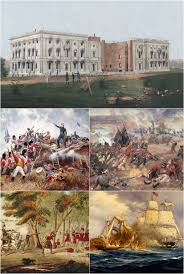
A number of campaigns may be readily identified but here we are concerned only with the Chesapeake Bay campaign conducted by Major General Robert Ross in the summer and early autumn of 1814, the highpoint of which was the British occupation of Washington and the burning of the Capitol and the Executive Mansion (normally referred to today as the White House) and several other public buildings.

Robert Ross was born in 1766 in Ross-Trevor (now Rostrevor), County Down. He graduated from Trinity College, Dublin, and joined the British Army. During the wars against Revolutionary and Napoleonic France Ross saw significant action in Spain, Egypt, Italy, and the Netherlands.  He was thrice wounded. On two occasions his wounds were severe.  For his conspicuous gallantry, leadership, and heroism, he was awarded three Gold Medals, the Peninsula Gold Medal, a Sword of Honour, and he received the thanks of Parliament.

Although a strict disciplinarian who drilled his men relentlessly, Ross was extremely popular with his men because of willingness to share in the hardships of his soldiers and fight alongside them in the thick of battle, a fact evidenced by his three wounds.  By 1812 Ross was a Major General.

On 19 August 1814 Ross and 5,400 British troops, many of them veterans of the Peninsular War, landed near Benedict on the Patuxent River in southern Maryland. Ross and troops then began to advance on Washington, some 40 miles away.

On the 24 August at Bladensburg, Maryland, Ross encountered a numerically superior American force commanded by Major General William H. Winder. Winder’s force consisted of 6,500 militiamen and 400 sailors and marines. Ross’s advance guard of 1,500 men routed the American force which fled in panic and disarray, so much so that the battle became known as the ‘Bladensburg Races’. The American militia fled through the streets of Washington, less than nine miles away. Only the American sailors and marines under the command of Commodore Joshua Barney acquitted themselves with honour.

Later that day the British entered Washington virtually unopposed, James Madison, the 4th President of the United States, along with the rest of the federal administration, having fled.

Ross sent a party under a flag of truce to agree to terms, but they were attacked by partisans from a house at the corner of Maryland Avenue, Constitution Avenue, and Second Street NE. This was to be the only resistance British troops encountered. The house was burned – the only private house to suffer that fate – and the Union Flag was raised above Washington.

The British set fire to the Capitol (seat of the Senate and the House of Representatives), the Library of Congress, the Executive Mansion (or White House), the US Treasury and other public buildings. The Americans themselves set fire to the Washington Navy Yard, founded by Thomas Jefferson, to prevent the capture of stores and ammunition, and the 44-gun frigate Columbia which was then under construction. For whatever reason the British spared the Marine Barracks, a decision often assumed to have been a chivalrous tribute to their exemplary conduct at Bladensburg.

The spirited conduct of Dolley Madison, the President’s wife, provides a  stark contrast with that of the American political and administrative elite. ‘The First Lady’ stayed in the Executive Mansion long after government officials (including her own bodyguard) had fled and is credited with saving several historic paintings, notably the Lansdowne Portrait, a full-length painting of George Washington by Gilbert Stuart, and various important artefacts. Mrs Madison was eventually prevailed upon to leave the Executive Mansion only moments before British troops entered the building. There the troops found the dining hall set for a dinner for 40 people. After consuming the banquet, they took souvenirs (including one of the president’s hats) and then set the building on fire.

The British occupied Washington for approximately 26 hours and then returned to their ships.

The Americans have always regarded the British raid on Washington as retaliation for Brigadier General Zebulon Pike’s burning of York (now Toronto), the capital of Upper Canada (now  Ontario), in the spring of 1813. Actually the British attacked Washington for ‘its likely political effect’ rather than mere retaliation for York. By attacking their enemy’s seat of government, the British were anticipating the Prussian soldier and military theorist Clausewitz’s understanding of the relationship between political objectives and military objectives in war, as set out Clausewitz’s military treatise Vom Kriege (published posthumously in 1832 and translated into English as On War): ‘Der Krieg ist eine bloße Fortsetzung der Politik mit anderen Mitteln’ (War is merely a continuation of politics by other means).

In September 1814 Ross mounted a raid on Baltimore while the Royal Navy attacked Fort McHenry. The American militia men, defending Baltimore from behind entrenchments, on this occasion acquitted themselves well and succeeded in repulsing Ross’s force and Ross was mortally wounded by an American sniper. Fort McHenry successfully withstood the Royal Navy’s bombardment, an event which prompted Francis Scott Key to write ‘The Star-Spangled Banner’.

American success in defending Baltimore and Fort McHenry offset the humiliation of the brief occupation of Washington and the destruction of so many of the city’s public buildings. The Executive Mansion sustained extensive damage. Only the external walls remained and, except for portions of the south wall, most of these had to be demolished and rebuilt because they had been weakened by the fire and their subsequent exposure to the elements. Unfortunately, there would appear to be no substance to the myth that the Executive Mansion was painted white to conceal the scorch marks. The Executive Mansion had been painted white since its construction in 1798.

Ross died while being transported back to the ships. After his death, the general’s body was stored in a barrel of Jamaican rum and shipped to Halifax, Nova Scotia, where he was buried on 29 September 1814.

Major General Robert Ross was the first (and to date only) soldier to capture Washington, a feat which eluded even great Robert E. Lee and the legendary Army of Northern Virginia fifty years later. Admittedly, Lee probably would not have wished to burn the American capital. Ross was also the first commander to defeat a full US army in the field.

There is a very fine memorial (dating from 1821) by Josephus Kendrick to  Ross in the south transept of St Paul’s Cathedral in London. Ross is also commemorated by a 100 foot granite obelisk erected in 1826 near his birthplace at Rostrevor. As an augmentation of honour the Ross family’s coat of arms was granted a second crest in which an arm is seen grasping the stars and stripes on a broken staff; and the family name was changed to Ross-of-Bladensburg.

Reconstruction of the White House began in early 1815 and was finished in time for President James Monroe’s inauguration in 1817. Reconstruction of the Capitol did not begin until 1815 and it was completed in 1864. Thomas Jefferson later sold his extensive personal library to the government to restock the Library of Congress.
The Road to Partition

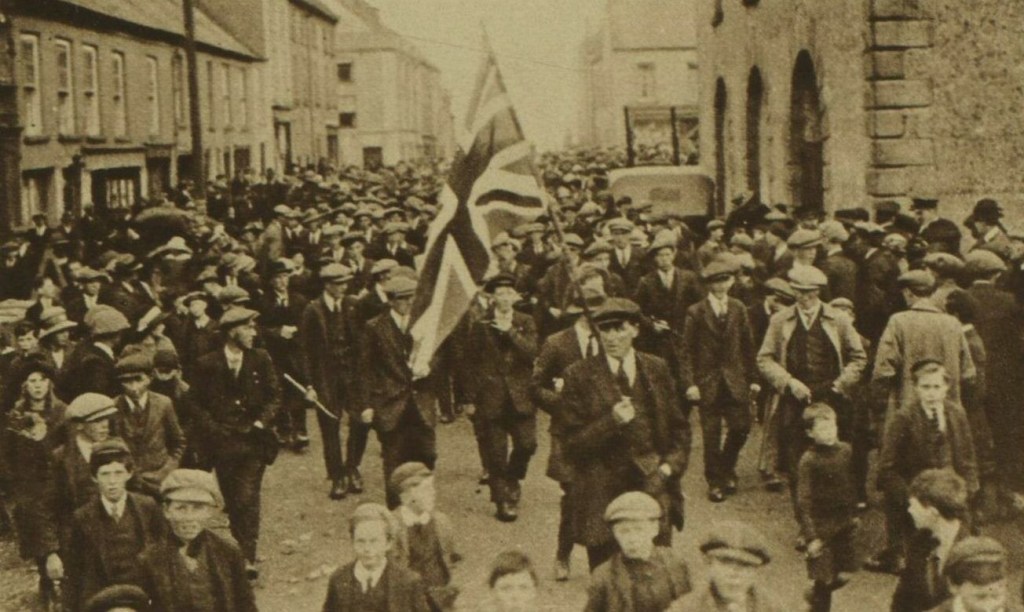
The Ulster History Project is looking at organising a series of talks on the road to partition, 1918 – 1922, which saw the foundation of Northern Ireland and Eire, or Irish Free State.

This is something we would look to begin in the spring but will be dependent on numbers in order to cover necessary overheads.

There would be a small charge to attend in order to cover the necessary costs.

If you are interested please register your details via http://eepurl.com/gdQuY5

Community Education

eight person huddling

The Ulster History Project is pleased to be partnering with the Sandy Row Community Forum in the running of a session on citizenship and voting in Northern Ireland.

One hundred years after the huge expansion in the electoral franchise, which permitted women to vote for the very first time and extended the franchise for men, this session with help to get you thinking about your rights & responsibilities as citizens.

If you are interested in a conversation about Unionism, Voting & Elections – come along on Thursday 24th January at 6.30pm in the Sandy Row Community Centre.

You will also be able to register to vote if you haven’t already done so! Please bring along with you your National Insurance Number!


Use 2019 to expand your knowledge

books on bookshelves

As we enter 2019 why not expand your knowledge through learning more about history?

2019 provides opportunities to learn more about Ulster history, including the path to the foundation of Northern Ireland, the Irish Civil War, the establishment of the Irish Free State and many more subjects.

This June will see the 75th anniversary of the D-Day Landings, the military operation to liberate Europe from German occupation.

Contact us if you have any questions, queries or suggestions.

You can host a one-off event or a series. Remember we come to you.

Prices start from only £75 per session (price varies on geographical location within Northern Ireland and the Border counties of Ireland).

Book now via email: info@ulsterhistoryproject.org.uk

New Year Resolution

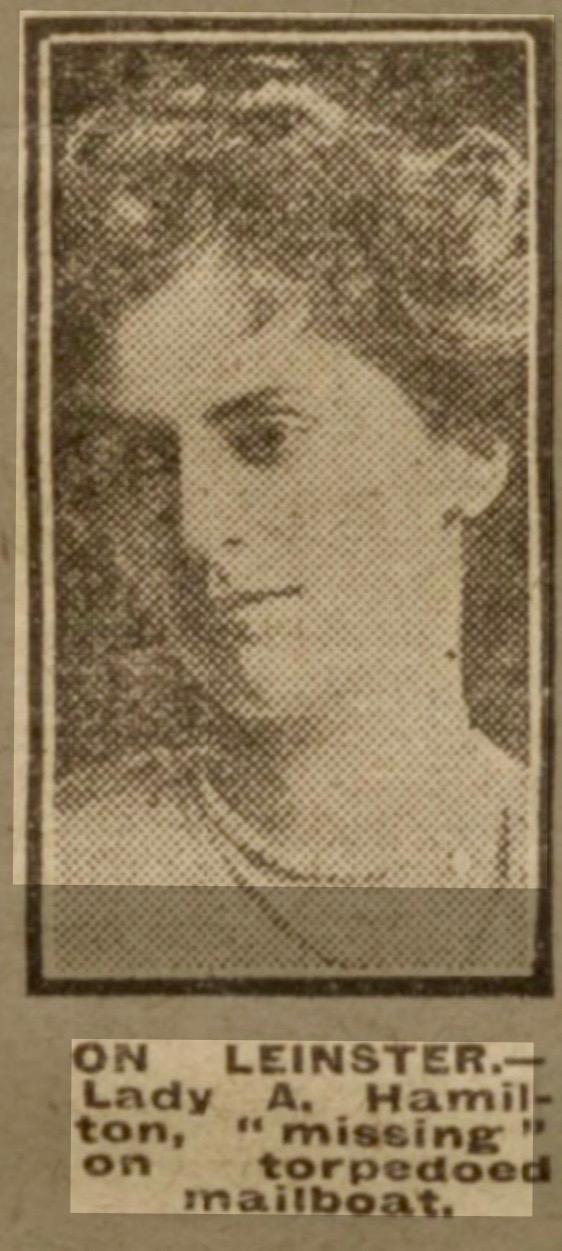
Lady Phyllis Hamilton and the sinking of the RMS Leinster

Lady Phyllis Hamilton and the RMS Leinster

Lady Phyllis Hamilton, picture courtesy of RMS Leinster Memorial Page

On 10 October 1918, a month and a day before the end of the Great War, the mail boat RMS Leinster was sunk by a German U-boat, with the loss of more than 500 lives. Although the official death toll was placed at 501, on the strength of recent research at least 565 people perished in what remains the greatest single loss of life in the Irish Sea.

The Leinster was one of four ships owned by the City of Dublin Steam Packet Company to operate a mail and passenger service between Kingstown and Holyhead in Anglesey. The other three ships were named RMS Connaught, RMS Munster and RMS Ulster. Collectively they were known as the ‘Provinces’. The prefix RMS is the abbreviation for Royal Mail Steamer.

Shortly before 9 am on 10 October the Leinster left Kingstown, under the command of Captain William Birch, a Dubliner who lived with his family in Holyhead. The ship had a crew of 77 and was carrying 694 passengers, of whom approximately 190 were civilians. The remainder were service personnel either returning to their units or going on leave. Some were nurses. Some of the service personnel were from Australia, New Zealand, Canada and the United States.

The most prominent Ulster casualty was Lady Alexandra Phyllis Hamilton, the 42-year-old daughter of James Hamilton, the 2nd Duke of Abercorn. She was travelling to London, accompanied by the family cook, Mrs Martha Bridge, and Eleanor Strachan, a servant.

Lady Phyllis remained calm and handed her lifejacket to someone else, observing, ‘I’m a strong swimmer.’ The Princess of Wales (the future Queen Alexandra and consort of Edward VII) had acted as sponsor at her baptism. She was also a cousin of Winston Churchill and one of five close relatives whom Churchill lost in the Great War. Of three members of the party, only Mrs Bridge’s body was ever recovered.

There is a memorial to Lady Phyllis and Lady Gladys Mary Hamilton, the Countess of Wicklow, erected by the Dowager Duchess of Abercorn, inside the beautiful little Church of Ireland church on the Baronscourt estate, near Newtownstewart. The Countess had died the previous year, aged 36.

Another significant casualty was Josephine Carr, the first Wren to die on duty. Daughter of Samuel and Kathleen Carr of 4 Bethesda Road, Blackrock, County Cork, she had enlisted in the newly-created Women’s Royal Naval Service (WRNS) in September 1917. She was 19 and was described as a clerk/shorthand typist. Josephine’s body was never recovered.

The sinking of the RMS Leinster attracted stern comment from President Woodrow Wilson who observed on 14 October: ‘At the very time that the German government approaches the government of the United States with proposals of peace its submarines are engaged in sinking passenger ships at sea.’

Germany responded on 20 October by agreeing to cease hostilities against merchant ships. The attacks stopped the following day.